
Acupuncture and Moxibustion
Chai Family Balance Acupuncture
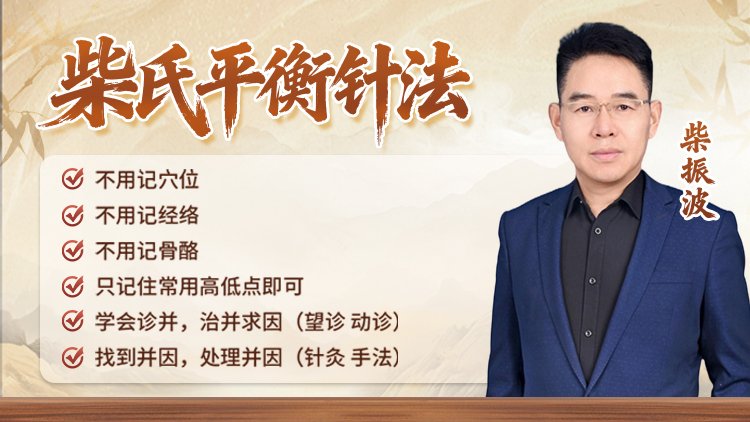
Systematically study the diagnostic approach, commonly used high and low points, visual and movement assessment, and needling standards in Chai Family Balance Acupuncture, building a learning path from observation to management.
About This Course
Course Introduction
This course is taught by Chai Zhenbo, a lineage instructor in Chai Family Balance Acupuncture. Its learning approach combines assessment, treatment, and seeking causes. Rather than centering on rote memorization of points, meridians, and bones, it begins with visual and movement assessment of posture, relative lengths, and mobility, then uses common high and low points to develop a management approach. Content includes foundational theory, core principles, procedural features, differences from traditional acupuncture, and practical cases involving shoulders, lower back and abdomen, cervical spine, knees, and cosmetic acupuncture. It is intended for learners seeking specialist needling knowledge, stronger observation and judgment, and a clear practical pathway.
Learn Step by Step
What You Will Learn
Study Chai Family Balance Acupuncture's basic theory, core principles, and procedural logic. Understand how visual assessment observes posture and differences in length, how movement assessment examines range of motion, and how these inform assessment and intervention.
The course explains how to study commonly used high and low points and describes basic procedural standards including 45-degree oblique filiform-needle insertion toward the bone surface, 3–5 lifting-thrusting movements, and no needle retention. Practical cases involving shoulders, lower back and abdomen, cervical spine, knees, and cosmetic acupuncture illustrate the progression from theory to application.
Course Structure
Course Outline
Public preview: the following lessons are those publicly displayed on the original website.
- 01
[Chai Family Balance Acupuncture] Chapter 01: Foundational Theory (Part 1) — Chai Zhenbo
- 02
[Chai Family Balance Acupuncture] Chapter 01: Basic Theory (Part 2 of 3) — Chai Zhenbo
- 03
[Chai Family Balance Acupuncture] Chapter 01 - Basic Theory (Part 2) - Chai Zhenbo
- 04
[Chai Family Balance Acupuncture] Chapter 02: Head and Neck (Part 1) — Chai Zhenbo
- 05
[Chai Family Balance Acupuncture] Chapter 02: Head and Neck (Part 2 of 3) — Chai Zhenbo
- 06
[Chai Family Balance Acupuncture] Chapter 02 - Head and Neck (Part 2) - Chai Zhenbo
- 07
[Chai Family Balance Acupuncture] Chapter 03 — Shoulder — Lesson 01: Foundational Overview — Chai Zhenbo
- 08
[Chai Family Balance Acupuncture] Chapter 03 - Shoulder - Lesson 02 - Limited Abduction - Chai Zhenbo
- 09
[Chai Family Balance Acupuncture] Chapter 03: Shoulder — Lesson 03: Restricted Extension — Chai Zhenbo
- 10
[Chai Family Balance Acupuncture] Chapter 03 — Shoulder — Lesson 04: Restricted Forward Flexion — Chai Zhenbo
Learning Experiences
Student Feedback
The instructor does more than explain concepts, connecting visual assessment, movement assessment, and management pathways.
The course includes many cases involving the shoulders, waist and abdomen, cervical spine and knees, which helped me understand the practical approach. Afterwards I had a clearer idea of which version to study first.