
Acupuncture and Moxibustion
Tung's Extraordinary Points
Study Tung's Extraordinary Points systematically, including its distinctive theory, point distribution, hand assessment, and standards for needling angle and depth.
About This Course
Course Introduction
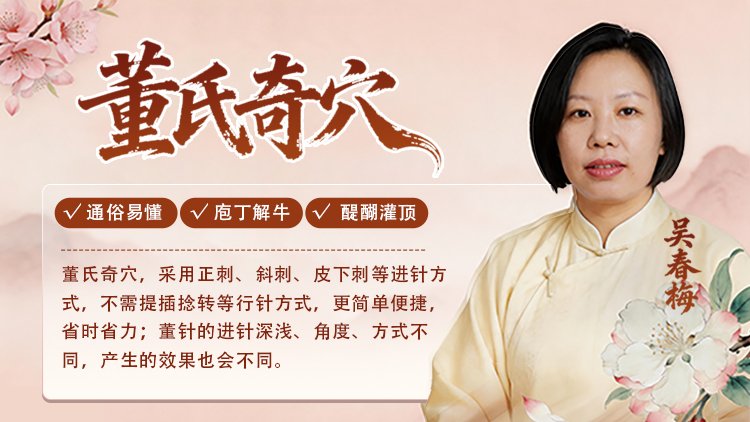
This course is taught by Wu Chunmei, described in the materials as a dual-certified TCM physician with over 20 years of clinical experience, teaching heritage-certified Tung's Extraordinary Points. The system is described as using few points and simple procedures without complex lifting, thrusting, or rotation, mainly selecting limb points for greater safety. Combined with its bloodletting methods, the course describes rapid effects for pain, acute conditions, chronic conditions, and difficult cases. Two online classes cover foundations and practical applications, with clinical point combinations and nine targeted bloodletting practices. The materials describe it as accessible for rapid learning by beginners and TCM practitioners, with applications in home care and attracting clients and increasing revenue in service settings.
Learn Step by Step
What You Will Learn
This course covers the distinctive theory and point distribution of Tung's Extra Points, palm assessment, standards for needle angle and depth, and accompanying bloodletting techniques. It examines five classic multipurpose point combinations—Da Santong, Shang Sanhuang, Sima points, Xia Sanhuang, and Xiao Santong—each discussed across multiple body systems. It systematically teaches standardized point-combination approaches for more than one hundred conditions involving the respiratory, digestive, cardiovascular and cerebrovascular, liver and gallbladder, urinary, rheumatic and metabolic, neurological and mental-health, gynecological and men's-health, skin, musculoskeletal, and sensory-organ fields. It also includes practical work in nine bloodletting zones. The foundation class covers basic points and condition-oriented needling, while the practical class develops zang-fu pattern-based point-combination reasoning to address both root and manifestation. Additional material includes specialist needle prescriptions, magnetic-bead therapy, and home-based business practice, with the stated aim of independent acupuncture-based support for common and chronic conditions.
Course Structure
Course Outline
The original site publicly lists the first 10 of 28 lessons.
- 01
[Tung's Extra-Point Acupuncture] Lesson 01 - Overview - Wu Chunmei
- 02
[Tung's Extraordinary Points] Lesson 02: Principles — Wu Chunmei
- 03
[Tung's Extraordinary Points] Lesson 03: Region 11 (Fingers) Points (Part 1) — Wu Chunmei
- 04
[Tung's Extra-Point Acupuncture] Lesson 04 - Region 11 (Fingers): Points (Part 2) - Wu Chunmei
- 05
[Tung's Extraordinary Points] Lesson 05: Region 11 (Fingers) Points (Part 2) — Wu Chunmei
- 06
[Tung's Extraordinary Points] Lesson 06: Region 22 (Palm) Points (Part 1) — Wu Chunmei
- 07
[Tung's Extra-Point Acupuncture] Lesson 07 - Region 22 (Palm): Points (Part 3) - Wu Chunmei
- 08
[Tung's Extraordinary Points] Lesson 08: Region 33 (Forearm) Points — Wu Chunmei
- 09
[Tung's Extraordinary Points] Lesson 09: Region 44 (Posterior Arm) Points — Wu Chunmei
- 10
[Tung's Extra-Point Acupuncture] Lesson 10 - Region 55 (Sole): Points - Wu Chunmei
Learning Experiences
Student Feedback
The instructor explains things clearly, covering not only the concepts but also how to organize your learning.
After reading the page, I had a clearer understanding of the differences between the basic and advanced versions.