
Bone-setting and Tuina
Chen Family Taiji Bone-setting
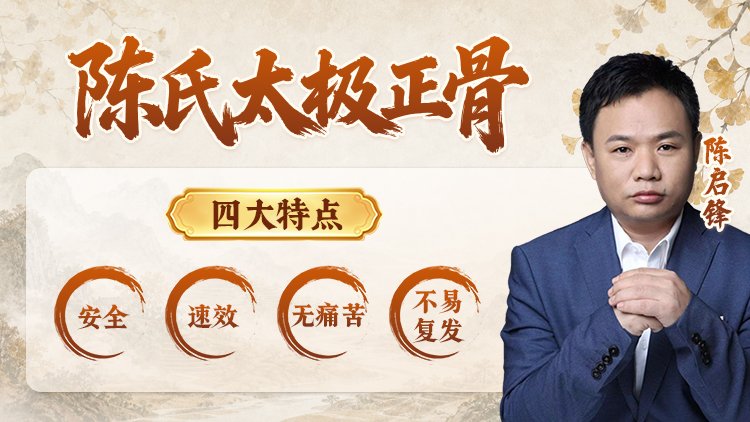
Chen Family Taiji Bone-setting, taught by Chen Qifeng, combines Taiji force principles, traditional bone-setting, Daoist medical wellness practices, and TCM's holistic perspective. Its learning principles emphasize leading the hands from the waist, coordinated whole-body force, supple sinews, and skeletal alignment. Rather than forceful cracking, it uses gentle, adaptable, coordinated methods to explore relationships among sinews and bones, the spine, qi and blood, and the zang-fu systems.
About This Course
Course Introduction
Chen Family Taiji Bone-setting, taught by Instructor Chen Qifeng, integrates Taiji force, traditional bone-setting, Daoist medical self-care, and TCM's holistic perspective. It emphasizes guiding the hands from the waist, coordinated whole-body force, supple sinews, and aligned bones. Gentle, adaptable, coordinated methods are used to explore relationships between sinews, bones, the spine, qi and blood, and zang-fu organs rather than forceful joint cracking. Integrating martial and medical practice with internal-external regulation, the course covers the reasoning behind bone-setting and sinew techniques, holistic TCM theory, qi and blood, and the causes of musculoskeletal injury. It is intended for bone-setting and tuina practitioners, physical therapists, wellness-business staff, and learners studying regulation approaches for the neck, shoulders, lower back, legs, spine, and sinew injuries.
Learn Step by Step
What You Will Learn
Learn the medical theory and techniques underlying Chen Family Taiji Bone-setting, including its holistic view of the Du vessel and spine as a unit and free flow as the basis for function. Explore TCM holism and qi-and-blood theory in spinal and sinew injuries.
Through common topics involving the cervical spine, shoulders, thoracic and lumbar spine, knees, ankles, pelvis, apparent leg-length differences, uneven shoulders, scoliosis, bow legs and knock knees, the course explains learning paths for sinew regulation, release, bone-setting and posture adjustment. Theory and cases help build a complete framework from assessment and localization to manual techniques.
Course Structure
Course Outline
Public preview: the following lessons are those publicly displayed on the original website.
- 01
[Chen Family Taiji Bone-setting] Theory — Lesson 01: Essential Understanding of Medical Principles, Techniques, and Causes
- 02
[Chen Family Taiji Bone-setting] Theory - Lesson 02 - Integrating the Du Vessel and Spine, Restoring Flow, and Holistic Pattern-Based Treatment - Chen Qifeng
- 03
[Chen Family Taiji Bone-setting] Theory — Lesson 03: TCM Holism in Spinal and Sinew Injuries — Chen Qifeng
- 04
[Chen Family Taiji Bone-setting] Theory — Lesson 04: How Qi-Blood Theory Guides Treatment of Sinew and Bone Injuries — Chen Qifeng
- 05
[Chen Family Taiji Bone-setting] Theory - Lesson 05 - Five-Step Cervical and Lumbar Treatment Method - Chen Qifeng
- 06
[Chen Family Taiji Bone-setting] Practical Cases - Lesson 01 - Cervical Spondylosis - Chen Qifeng
- 07
[Chen Family Taiji Bone-setting] Practical Cases — Lesson 02: Frozen Shoulder — Chen Qifeng
- 08
[Chen Family Taiji Bone-setting] Practical Cases — Lesson 03: Thoracic Spine Conditions — Chen Qifeng
- 09
[Chen Family Taiji Bone-setting] Practical Cases - Lesson 04 - Costochondritis - Chen Qifeng
- 10
[Chen Family Taiji Bone-setting] Practical Cases — Lesson 05: Lumbar Disc Herniation — Chen Qifeng
Learning Experiences
Student Feedback
I thought bone-setting required a lot of force. This course helped me understand using the waist to guide the hands and generating force through the whole body.
By treating the cervical spine, lumbar spine, pelvis and postural concerns separately, the course provides a clear structure for practitioners' systematic review.
Taiji bone-setting has a distinctive approach: gentle, yet focused on whole-body coordination. Developing the feel of the techniques requires repeated practice with the instructor.