
Specialist TCM Courses
Taiyi Qiankun Practice
Study inherited Daoist regulation approaches and build a practical self-care framework through hand and foot points, yin-yang point combinations, daoyin movement and kneading, and balancing qi and blood.
About This Course
Course Introduction
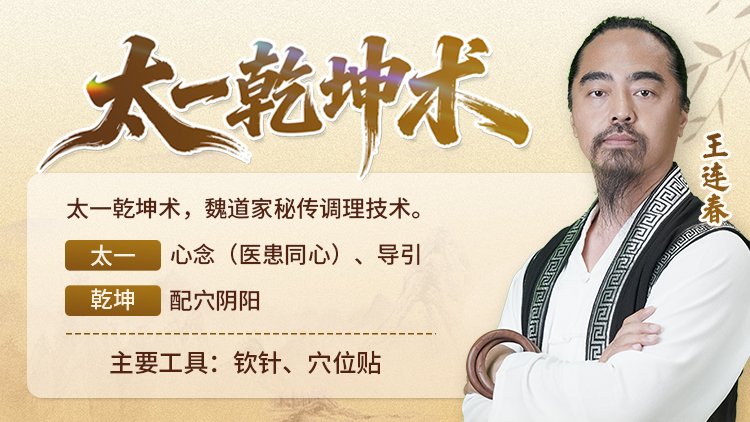
Taiyi Qiankun Practice is taught by Wang Lianchun, also known as Daoist Qingfeng. Drawing on a transmitted Daoist regulation tradition, it explores Taiyi and Qiankun: Taiyi emphasizes intention, daoyin, and cooperation between practitioner and recipient; Qiankun emphasizes yin-yang point combinations and qi-and-blood balance. Using hand and foot points, press needles, acupoint patches, moxibustion, and fingers in place of needles, students learn to locate painful points, combine guidance with pressing and kneading, and develop flexible regulation approaches suitable for home practice. Rather than beginning with extensive memorization of point functions, it starts with common concerns, frequently used points, and procedural sequences. It is intended for TCM enthusiasts, wellness practitioners, and those seeking to improve family health-management knowledge.
Learn Step by Step
What You Will Learn
This course introduces the core ideas of Taiyi Qiankun Practice, exploring relationships between the palms and fourteen meridians, yin–yang convergence, the traditional connection of the ten fingers with the heart, and the movement of qi and blood. It explains a repeatable home-practice framework using tender-point location, acupoint applications, guided movement and pressing or kneading, and simple tools.
Study cases cover musculoskeletal, nervous, cardiovascular, respiratory, digestive, gynecological and reproductive, urinary, sense-organ, skin, and oral topics. The course gradually introduces a basic sequence of finding painful points, combining acupoints, performing daoyin, and observing responses, with applications presented for everyday wellness, business client outreach, client communication, and supportive family care.
Course Structure
Course Outline
Public preview: the following lessons are those publicly displayed on the original website.
- 01
[Taiyi Qiankun Practice] Lesson 00: Overview — Wang Lianchun
- 02
[Taiyi Qiankun Practice] Lesson 01 - Forehead Pain - Wang Lianchun
- 03
[Taiyi Qiankun Practice] Lesson 02: One-Sided Headache — Wang Lianchun
- 04
[Taiyi Qiankun Practice] Lesson 03 - Pain at the Back of the Head - Wang Lianchun
- 05
[Taiyi Qiankun Practice] Lesson 04: Pain at the Crown of the Head — Wang Lianchun
- 06
[Taiyi Qiankun Practice] Lesson 05: Whole-Head Headache — Wang Lianchun
- 07
[Taiyi Qiankun Practice] Lesson 06 - Nasal Congestion - Wang Lianchun
- 08
[Taiyi Qiankun Practice] Lesson 07: Ear Pain — Wang Lianchun
- 09
[Taiyi Qiankun Practice] Lesson 08: Mouth Ulcers — Wang Lianchun
- 10
[Taiyi Qiankun Practice] Lesson 09 - Toothache and Swollen, Painful Gums - Wang Lianchun
Learning Experiences
Student Feedback
What makes this beginner-friendly is that you do not have to memorize many points immediately. You start with finding pain sites and learning the procedure, which is easier to follow.
Combining hand and foot points with guided movement and pressing or kneading is practical, and makes the approach easier to explain to my wellness clients.
The content is broad. It is advisable to practice around common concerns first, then gradually understand yin-yang point combinations and qi-blood balancing.