
External Therapies
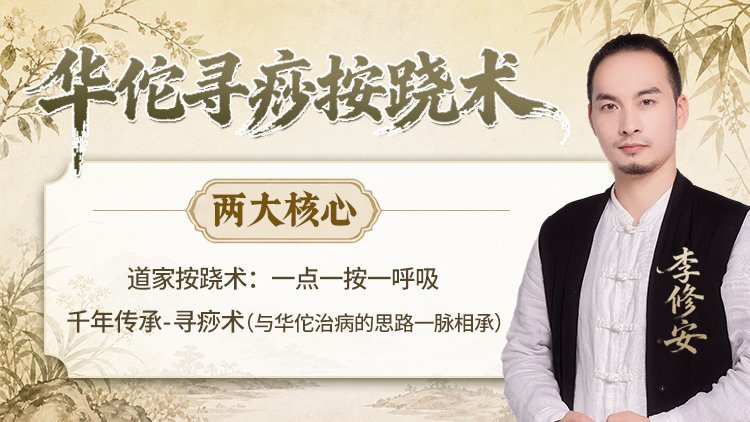
Hua Tuo Xunsha Anqiao Manual Therapy
Study external-therapy approaches to fascial tissues, spaces between bones, zang-fu systems, and qi-and-blood stagnation through tracing, pressing, and releasing techniques, without needles, medicines, or breaking the skin.
About This Course
Course Introduction
Hua Tuo Xunsha Anqiao Manual Therapy, taught by Li Xiu'an, follows an external approach of finding, pressing, and tapping. Presented as noninvasive and without breaking the skin, it explores meridian blockage points and traditional deep sha responses to understand descriptions of blockage involving fascia, skeletal spaces, zang-fu systems, and blood. Key topics include sha identification, Daoist anqiao techniques, sha color and shape assessment, control of angle, speed, and force, and case analysis involving shoulders, knees, gout, breasts, heart-brain concerns, and longstanding conditions.
Learn Step by Step
What You Will Learn
Learn Xunsha Anqiao principles, recognition of sha signs, procedural mnemonics, and practice areas for common concerns.
The course lends itself to notes on traditional meanings of red, purple, black, and white sha colors, and responses such as dots, patches, blood blisters, and raised areas, for review before and after practice.
Course Structure
Course Outline
Public preview: the following lessons are those publicly displayed on the original website.
- 01
[Hua Tuo Xunsha Anqiao Manual Therapy] Lesson 01 - Basic Theory - Li Xiu'an
- 02
[Hua Tuo Xunsha Anqiao Manual Therapy] Lesson 02: What Is Sha? — Li Xiu'an
- 03
[Hua Tuo Xunsha Anqiao Manual Therapy] Lesson 03: Essentials of Identifying Sha — Li Xiu'an
- 04
[Hua Tuo Xunsha Anqiao Manual Therapy] Lesson 04 - Differences Between Xunsha, Cupping, and Gua Sha - Li Xiu'an
- 05
[Hua Tuo Xunsha Anqiao Manual Therapy] Lesson 05: Distinguishing Xunsha Findings from Blood Stasis — Li Xiu'an
- 06
[Hua Tuo Xunsha Anqiao Manual Therapy] Lesson 06: Sha-Identification Mnemonics and Guiding Principles — Li Xiu'an
- 07
[Hua Tuo Xunsha Anqiao Manual Therapy] Lesson 07 - Recognizing Sha Presentations to Differentiate Conditions and Patterns - Li Xiu'an
- 08
[Hua Tuo Xunsha Anqiao Manual Therapy] Lesson 08: Where Does the Sha Revealed by Xunsha Go? — Li Xiu'an
- 09
[Hua Tuo Xunsha Anqiao Manual Therapy] Lesson 09: Precautions for Identifying Sha — Li Xiu'an
- 10
[Hua Tuo Xunsha Anqiao Manual Therapy] Lesson 10 - Basic Theory of Daoist Anqiao - Li Xiu'an
Learning Experiences
Student Feedback
Sha color and shape are practical to study and help me compare changes before and after regulation.
Because it uses neither needles nor medicines, clients are more receptive to it, and the practical approach is clear.
When the instructor discussed shoulder and knee cases, I could quickly connect them with actual client concerns.